
A major cause of maternal death for U.S. Black women are the high blood pressure conditions of Preeclampsia and its more serious form — eclampsia. According to research published in the American Journal of Public Health, Black women die from these pregnancy-related blood pressure disorders at roughly five times the rate of white women.
Preeclampsia and eclampsia can be dangerous to mother and baby because the mother’s blood pressure rises and reduces blood supply to her baby. It’s a major cause of preterm birth.
Preeclampsia:
- Can happen before or after delivery
- Involves high blood pressure beginning at 20 weeks or later
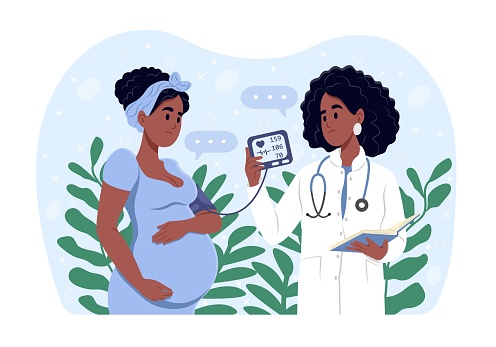
- Includes blood pressure of 140/90 or more, swelling, and protein in urine
- Can occur after your baby is born (postpartum preeclampsia):
- Usually happens between 48 hours and 6 after delivery
- Can cause upper nausea, vomiting, upper abdominal pain, high blood pressure, changes in vision, and headaches postpartum
Eclampsia:
- Involves preeclampsia serious enough to cause seizures or coma
- Can include additional complications including liver damage, increased bleeding risk
- Can occur after delivery (postpartum eclampsia) causing breathing difficulty and high blood pressure
- Occurs directly after delivery in 33% of cases and more than 48 hours after giving birth in one 50%
- Although experts have known the signs of this dangerous condition they have not understood the cause. However, a team at the University of Michigan believes it has found an answer. For Black women this answer could be among the most important medical advances in a generation.
What Scientists Found
Researchers studying why autoimmune diseases like lupus hit women more than men learned of a possible clue — a gene called VGLL3 — which turns other genes on and off, controls blood vessel growth, inflammation, and immune responses. In preeclampsia, the researchers found that VGLL3 gets stuck “on” in the placenta (the sac that holds the fetus) — throwing the body into overdrive. Lead researcher Dr. Johann Gudjonsson compares it to a thermostat turned up too high.
This is an exciting finding for two reasons: (1) An overactive VGLL3 appears be close to the true cause of preeclampsia, happening before the symptoms and warning signs for which doctors test and (2) When the team turned VGLL3 down in tissue from a human placenta, they were able to normalize or even reverse features of the disease. Published in the journal Circulation, the findings point toward a potential path to diagnosis, treatment, and even preventing root causes.
Three Ways This Could Help Close the Gap
For Black women specifically, the promise breaks down into three real possibilities.
Better diagnosis. Preeclampsia is dangerous partly because it’s easy to miss — and easy to dismiss. Many Black women describe their pain or symptoms only to be ignored, disbelieved, or under-treated. A clear gene marker could improve diagnosis by taking subjectivity and bias out of deliver and recovery rooms.
Real treatment. Currently, the only “cure” is delivering your baby. Any drug targeting VGLL3 is likely is years away, but could mean a Black mother no longer has to choose between her own health and a dangerously premature birth.
Prevention. Catching the disease at its source could stop the harm before it starts, rather than racing to manage a crisis after it happens.
One Tool Does Not Fix a System
The reason Black women suffer more from preeclampsia is not simply biology. Our health disparities also come from the toll of living Black in America — the chronic stress of racism, unequal access to quality care, and the way our symptoms are too often overlooked. A VGLL3 drug cannot fix any of that. So we welcome this breakthrough but a discovery only reduces Black maternal mortality if it actually reaches our mothers. That means clinical trials that include Black women. It means access that doesn’t depend on zip code or insurance. It means providers trained to listen. And it means the rest of us — advocates, patients, families, voters — refusing to let this be another advance that fails to reach communities that needed it most.
See sources here.